Thursday

The Other Side of Time


I'd try any reader's patience if I copied every passage from Celine that moved me. I'm posting the following because it introduced a lucid moment into an otherwise disordered day. I also feel like it offers some consolation to the late twenties/early thirties set, if only to know that someone else has traversed the dark spaces of this time in life and managed to do so with eyes open. This paradox of clear vision in deep darkness is an important figure for Celine and I find it gives me a sort of hope, despite the often melancholic tone. Without further ado, this passage is from Journey to the End of the Night, Ralf Manheim translation.

In the whole of your absurd past you discover so much that's absurd, so much deceit and credulity, that it might be a good idea to stop being young this minute, to wait for youth to break away from you and pass you by, to watch it going away, receding in the distance, to see all its vanity, run your hand through the empty space it has left behind, take a last look at it, and then start moving, make sure your youth has really gone, and then calmly, all by yourself, cross to the other side of Time to see what people and things really look like.

To be clear, I'm not encouraging a radical break with the past. But, I appreciate seeing the temptation laid bare in all of its metaphysical seductiveness. By giving voice to the desire, I feel like Celine relieves some of the anxiety that builds from its inscrutable force. I guess, in a sense, this is a typical romantic trope: using poetry to transform pain into a sublime aesthetic of self-reflection. But Celine's black humor keeps the reader from lapsing into a solipsistic enthusiasm. There's no heroism of spirit here, only an excess of vision that borders on the neurotic. And we are the beneficiaries of this excess. At least, I like to think so.

Tuesday

Knowledge in Equipoise


In his introduction to The Presocratics, Philip Wheelwright makes a rather profound point in the course of a brief aside. He's just finished explaining the significance of Anaximander's cosmological breakthrough - the philosopher proposed that "the earth is poised at the center of the universe, held in place by the fact that the universe extends equally on all sides of it," an incredibly novel theory given that his teacher, Thales, believed that the earth merely floated on interminable waters, thus suggesting an absolute up-down gravitational relation in contrast to Anaximander's more sophisticated notion of gravitational equipoise - when his attentions turn, momentarily, to a more characteristically modern question of social episteme and discourse. Wheelwright remarks that, despite the revolutionary import of Anaximander's astrological thesis, subsequent Greek philosophers continued to speak in terms of a "Way Up" and "Way Down," describing those cosmological parameters delineated by the Thalesian view. In offering a brief explanation for this discursive anachronism, Wheelwright explains, "Overt cosmological doctrines were, then as now, often combined with habits of thought and idiom drawn from another source." This other source, of course, is the pre-revolutionary past; the epistemological strata which survives its own refutation through a sort of discursive inertia.

However, the dimensions of this argument take a slightly different form if we apply it to Wheelwright's subsequent discussion of ontology among the Presocratics. Wheelwright argues that the "general ontological question of 'What?' is never a pure question: it rests upon certain assumptions as to the kinds of answer that are possible or acceptable." Here, Wheelwright again appeals to discursive limitations, though in a more radical manner. He explains:

Suppose that someone today, theorizing about the essential nature of things, were to propose the view that everything is ultimately electricity, or nuclear energy, or something of that sort: a listener, even if he were to reject the answer as too narrow, or even to dismiss the query as futile, would still regard the answer as making a kind of sense; but if the theorizer were to propose the answer that everything is ultimately water, or air, or an interplay of qualities like bright, dark, moist, dry, etc., he would generally be dismissed either as a fool or as a poet playing with fancies.

A new discursive force is identified, one which opposes the inertia previously described with regard to cosmological views. In approaching ontological questions, Wheelwright suggests that contemporary terms are privileged against their predecessors in a relation of rational ("making sense") to irrational (foolish, "playing with fancies").

A curious kind of tension emerges between these two points. Wheelwright appears to be saying two different things about the limits of knowledge and, specifically, the types of questions or investigations into knowledge we can attempt. On the one hand, our discourse is riddled with propositions which we know consciously to be factually invalid and even pre-critical. On the other hand, our critical practice is limited by what appears to be rational, as this rationality relates to contemporary views and technologies against the overturned views and technologies of past (and often present) societies and cultures. What then is the place (or time) of discourse in this push and pull against another discourse ("another source")?

Perhaps our knowledge spins in a sort of equipoise, rather than the absolute up-down relationship of critical progress against a pre-critical past. These other sources of knowledge aren't merely the shadow of our current enlightenment. Instead, what we know appears to balance in an acceptance/resistance of what we reject as knowledge proper. Such an Anaximanderian re-evaluation of perspective could prove just as relevant to contemporary questions of social episteme as it did to the questions of astrology which preoccupied that philosopher's time.

Saturday

From Rene Char's "Artine"


To offer a glass of water to a horseman as he passes hurtling headlong on a racetrack invaded by the crowd takes an absolute awkwardness on both sides; Artine brought to the minds she visited this monumental drought.

Translation by Mary Ann Caws

I recently picked up Rene Char: Selected Poems after reading of Char's influence on Foucault in James Miller's controversial biography of the philosopher, The Passion of Michel Foucault. The first French edition of Madness and Civilization included one of Char's prose poems, "Partage Formel", as an epigraph and the introduction, later re-written by Foucault, included an explanation of Char's influence on the work, stating, "[for] a rule of method I have retained only one, that which is contained in a text of Char, where can be read as well a definition of the most urgent and reserved truth: 'I removed from things the illusion they produce to protect us, and left them the part that they grant us.'" An early member of the Surrealist movement and later a captain in the French Resistance, Char's biography and hermetic prose piqued my interest. What I've read so far in Selected Poems has been incredibly rich and rewarding of the patience required to parse the poet's dense prose. The above sentence alone has occupied by mind for some weeks now. Like Bataille, Blanchot and other French writers who rejected Breton's efforts to calcify Surrealism in the form of a modern cult-religion, Char's work reminds us that this movement still offers fresh insights beyond its more conspicuous novelties.

Friday

Shoving Off Into the Vast etc.


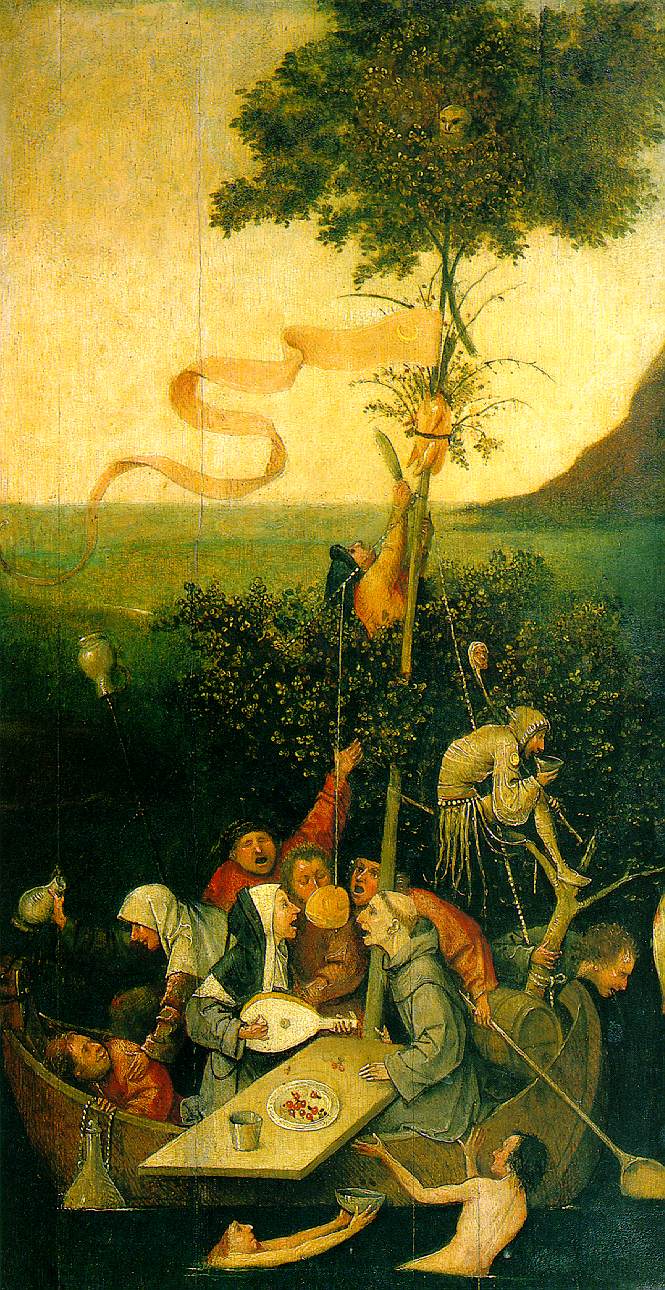
After a full year at dock, it’s high time Compendium Tremendium shoved off on its maiden voyage to the center of your kind attentions. In the spirit of this figurative adventure, I’m throwing caution to the wind and just writing. This blog was born from a desire to write and to write more, so there’s no use in my hesitating over the particulars of argument, audience and content. This will be my sole disclaimer for what follows. There are innumerable blogs which feature well-argued and compelling interventions into current events and polemics of all types and intensities. While I’m still too proud to say that this blog won’t be counted among their ranks, I feel nonetheless compelled to warn potential readers that nothing of the sort can be guaranteed. Instead, I encourage you, present reader, to regard these scribblings with the generous and itinerant gaze of the flaneur. I suppose this comes naturally to most web-based info-consumption, but just the same. Feel free to add comments if you’d like. Where appropriate, I will try to respond; however, I reserve the right to hold silent whenever I see fit/am feeling lazy.

More posts to follow… shortly.